




One of the most common questions that our genetics team hears is:
“Why don’t my puppy’s results match their sibling’s?”
If they share the same parents, shouldn’t the results be identical? The short answer is no, and the genetics behind it can create surprising outcomes.
What happens?
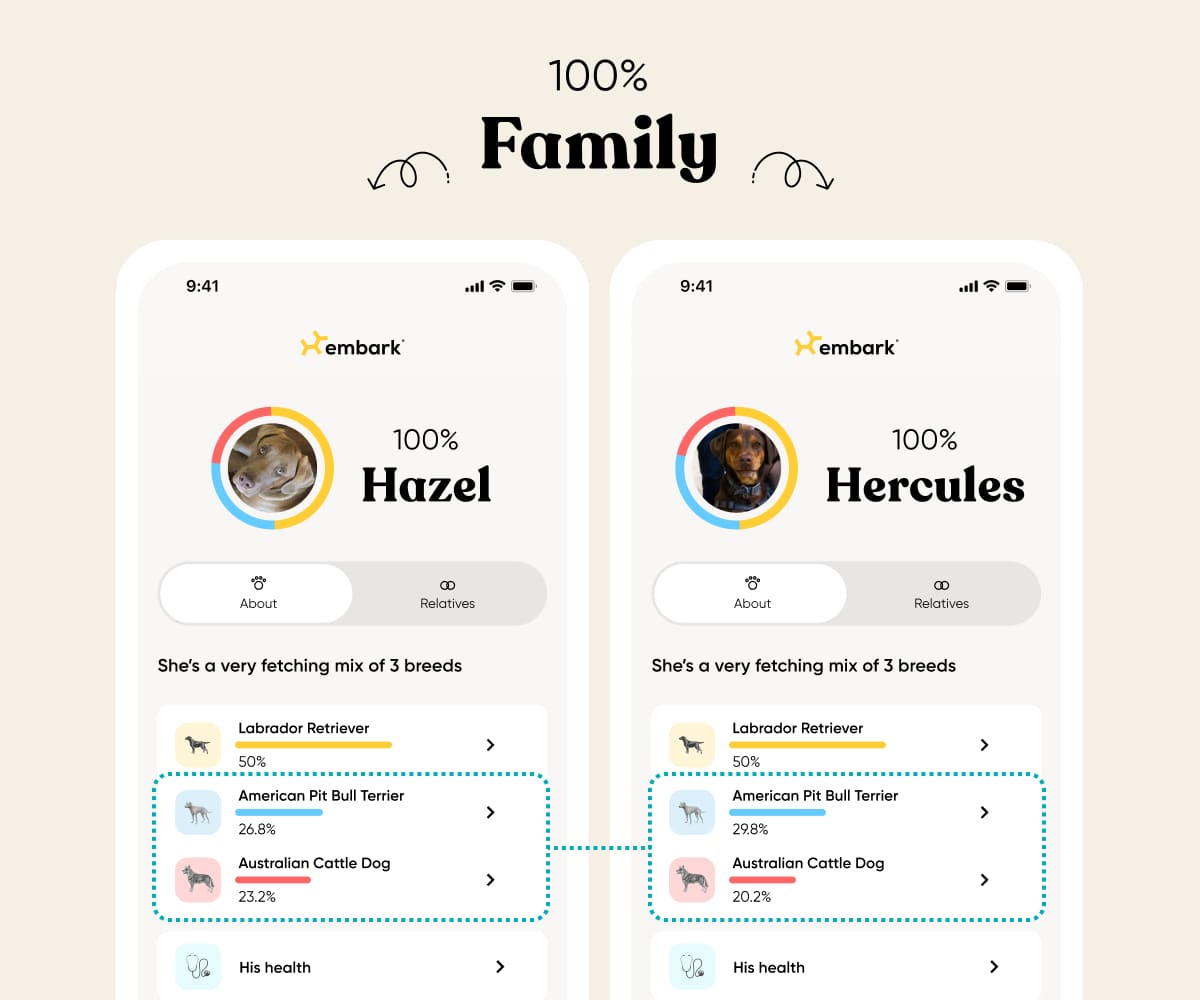
Every dog inherits half of their DNA from their mom and half from their dad, but siblings don’t inherit the same halves.
Before parental DNA is passed down, it undergoes a mixing process called genetic recombination, or reshuffling. This creates a new gene combination every time. As a result, each puppy receives a different genetic mix, even within the same litter.
This happens to human siblings, too. Children in the same family can have different eye colors, hair textures, or athletic builds, with one well-known exception: identical twins. While dogs often have multiple littermates, identical twins are extremely rare in the canine world.
Here’s what that concept can look like in real life.
Meet Hazel and Hercules
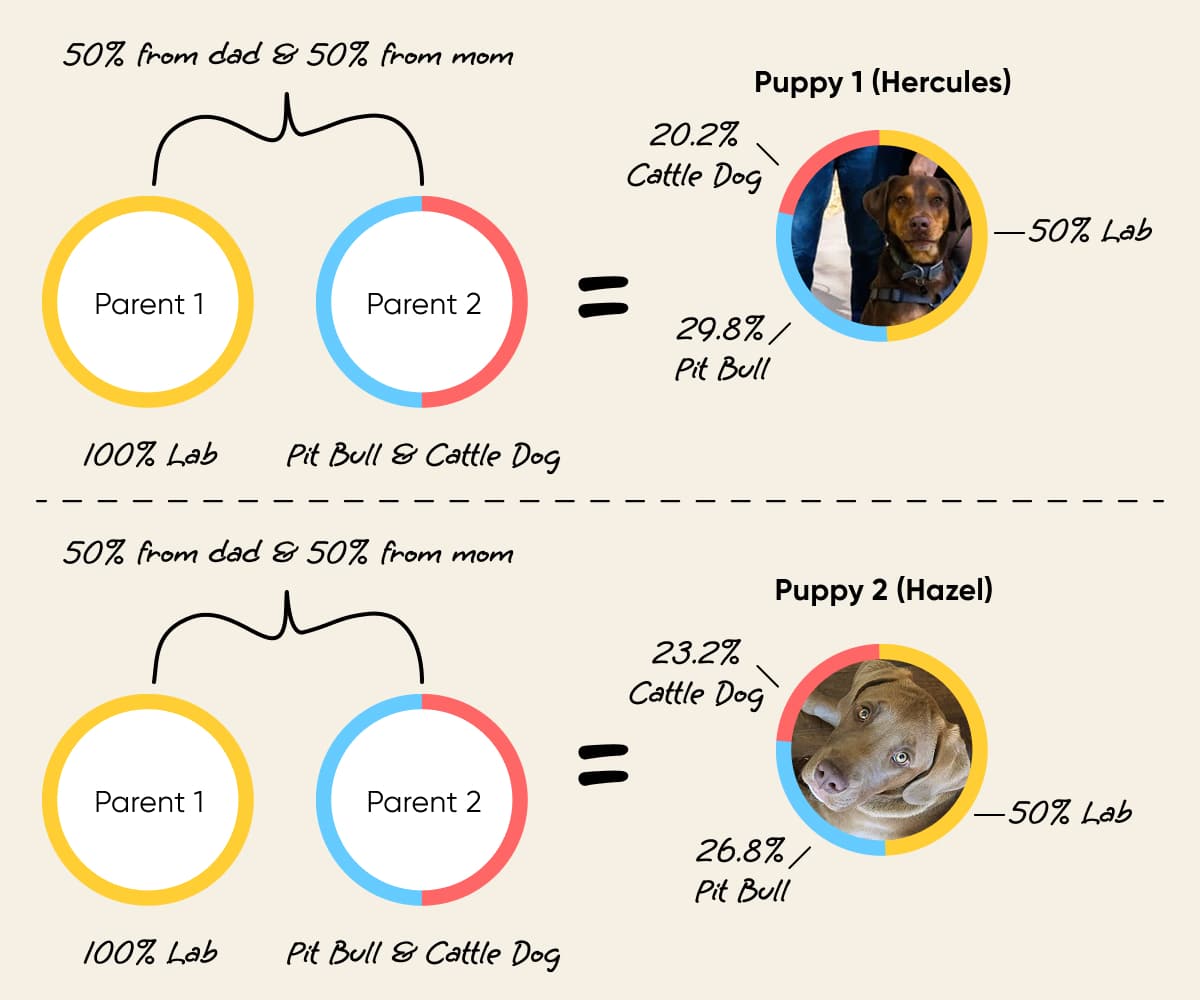
After testing Hazel, her owner, Tom, discovered she had a littermate through Embark’s Relative Finder. They shared the same parents, but their results were not identical.
One parent was likely a purebred Labrador Retriever, as both inherited 50% Labrador DNA. However, they inherited slightly different proportions of American Pit Bull Terrier and Australian Cattle Dog. Those differences contributed to their distinct markings, colors, and builds.
How does this affect breed ancestry results?
When two dogs of the same breed have puppies, all of the puppies will be 100% that breed. So as you’d imagine, if both parents are Labrador Retrievers, the puppies will also be Labrador Retrievers.
When two purebred parents of different breeds have puppies — often called a first-generation or F1 cross — the puppies will be 50% of each breed. In this case, if one parent is 100% Labrador Retriever and the other is 100% Poodle, the puppies will be 50% Labrador and 50% Poodle.
When the parents are mixed-breed, siblings can inherit different proportions of their ancestral DNA. That’s why reported breed percentages may vary between siblings.
What about health and trait results?
Because siblings inherit different combinations of genes, they can also differ in their physical traits and inherited health risks. This is true regardless of whether they’re purebred or mixed-breed.
To know exactly what each puppy in a litter inherited, each puppy would need to be tested individually.
What this means for your pup
Every dog has a unique genetic profile. Testing your pup reveals their specific mix of breed ancestry, physical traits, and inherited health conditions, giving you insights that can help you make smarter choices about day-to-day care – all personalized to your dog.
Want to learn more?
Frequently Asked Questions
Q: How does genetic recombination (reshuffling) actually work?
A: Dogs have 39 pairs of chromosomes. They inherit one set of chromosomes from their mother and one from their father. Before a parent’s DNA enters an egg or sperm cell, it undergoes two natural mixing steps. First, only one chromosome from each pair is passed on, and which one is chosen is random (think of a coin flip). Second, the paired chromosomes swap small pieces of DNA, creating blended versions rather than intact copies (reshuffling). Together, these processes create a new genetic combination each time, which is why littermates inherit different mixes of DNA even though they share the same parents.
Q: What is the purpose of genetic recombination (reshuffling)?
A: Genetic recombination helps create variation from one generation to the next. This mixing ensures that offspring are not clones of their parents or their siblings. Genetic variation is important because it allows populations to stay diverse and better adapt over time.
Q: Can littermates have different breed breakdowns?
A: Yes. Even though littermates share the same parents, each puppy inherits a different combination of their parents’ DNA. When parents are mixed-breed, this can lead to slight differences in reported breed percentages among siblings. In first-generation crosses between two purebred dogs of different breeds, puppies will typically be 50 percent of each breed. If both parents are the same purebred breed, the breed breakdown will be the same for all puppies.
Q: What could cause a sibling tested years ago to have a different breed mix?
A: Over time, we update and expand our reference panel as we collect more high-quality DNA samples from dogs around the world. These improvements allow us to refine how we identify and differentiate breeds. As a result, dogs tested in different years may have slightly different breed breakdowns, even if they are siblings. These updates reflect increased accuracy and resolution in our analysis, not changes to your dog’s DNA.
Q: Can purebred littermates look different?
A: Yes. Even when both parents are the same purebred breed, each puppy inherits a different combination of gene variants. This can result in differences in coat color, markings, size, and other physical traits within the same litter, even though all the puppies are of the same breed.
Q: Can littermates have different fathers?
A: Yes, littermates can have different fathers. Females can mate with more than one male, resulting in a single litter that includes both full siblings and half siblings. DNA testing can determine whether littermates share the same father.
Q: How can a dog’s sibling be a different age?
A: Dogs from the same litter are born at the same time, so true littermates are always the same age. However, a dog can have siblings from different litters if the same parents were bred again later. In those cases, the dogs share parents but were born months or years apart. DNA testing can identify these sibling relationships even when the dogs are of different ages.
Q: Is it enough to test one littermate, or do I need to test the whole litter?
A: If both parents have been DNA tested, you can understand the range of genetic variants and breed ancestry that are possible in their puppies. However, each puppy still inherits a different combination of that DNA. This means siblings can potentially differ in breed ancestry, traits, and health risks. To know a specific puppy’s results, that individual puppy would need to be tested.
Q: Can littermates have the exact same DNA?
A: In almost all cases, no. Littermates inherit different combinations of their parents’ DNA, so their genetic makeup is not identical. The only exception would be identical twins, which occur when a single fertilized egg splits early in development. Identical twins are very rare in dogs, so most littermates do not have identical DNA.


